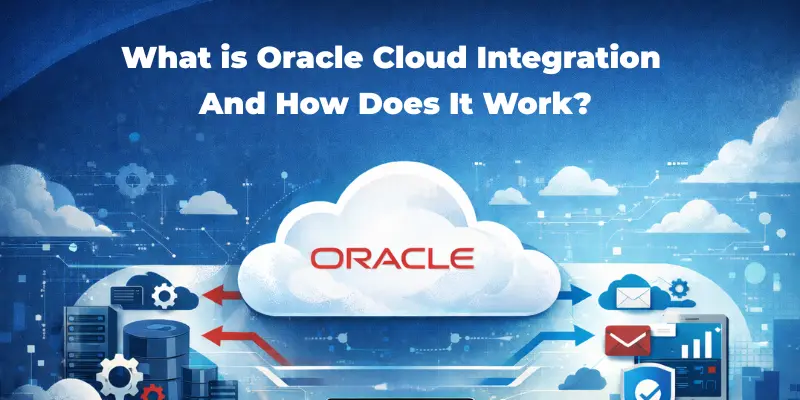
Oracle Cloud Integration is a cloud service that connects applications, data, and systems through a secure platform. It gives a business the ability to integrate Oracle Cloud applications and on-premise tools via guided integration flows. Hence, companies can transfer data swiftly, limit mistakes, and oversee all their integrations from one single dashboard.
What is Oracle Cloud Integration?
Oracle Cloud Integration is a tool that allows organizations to integrate a variety of software systems in a stable and well-planned manner. It is a great fit for today’s businesses, as i,t on the one hand, supports cloud systems and, on the other hand, supports on-premise systems.
Oracle Cloud Integration as a Central Platform
Oracle Cloud Integration serves as the central platform where all the integrations are managed in one place. Without writing a lot of code, it can connect ERP, CRM, and custom systems. Consequently, employees have access to every data exchange.
Major features:
- Prebuilt adapters
Prebuilt adapters enable systems to connect quickly without any complicated setup. These adapters not only support Oracle tools but also third-party applications. Thus, integration initiatives get off the ground sooner and require less personnel time.
- Visual integration design
The software comes with visual design tools to create integrations. Its users design flows by identifying steps and data mapping. Hence, a small team can still feel comfortable in integration tasks.
How Oracle Cloud Integration Operates
Integration for Cloud has a well-defined and organized way of transferring data securely. It checks for correctness at each step; thus, it is a great support for regular business activities.
Oracle Cloud Integration Integration Flow
Oracle Cloud Integration starts by identifying the source and target systems first. Then it relates data fields between connected applications. Finally, the system executes integrations through events or schedules.
Main steps include:
- Trigger setup
Triggers determine when an integration is commenced. They may be switched on as a result of actions, updates, or fixed schedules. Hence, data gets transferred automatically without human input.
- Data mapping
Data mapping connects fields between systems in an understandable format. This method guarantees that the values remain the same across different platforms. Therefore, reports and records are kept precise.
- Tracking and monitoring
Monitoring is ensured by tools that keep track of every integration step in the live mode. Teams have access to logs and can locate problems in no time. Hence, resolving issues becomes much quicker and less complicated.
Key Elements of Oracle Cloud Integration
Oracle Cloud Integration comprises tools that make it easy to carry out complicated integration work. Every component facilitates the exchange of data smoothly and reliably.
Oracle Cloud Integration Adapters and Connections
Integration for Cloud relies on adapters to link applications and databases. These adapters are compatible with SaaS tools, REST services, and on-premise systems.
Common components include:
- Connection manager
The connection manager keeps connection details securely. It enables the reuse of configurations for various integrations. This way, it takes less time to set up, and consistency is enhanced.
- Integration patterns
Integration patterns specify the means of communication between systems. They facilitate app-to-app and basic routing scenarios. Thus, integration designs remain clean and structured.
Benefits of Using Oracle Cloud Integration
Oracle Cloud Integration provides business teams with tangible benefits. It changes the game in terms of speed, accuracy, and operational efficiency.
Oracle Cloud Integration Business Advantages
One of the advantages of Oracle Integration is the reduction of manual data handling. Therefore, team members have more time for strategic activities.
Main benefits include:
- Faster deployment
Prebuilt components pay for shorter implementation times. Organizations can perform integration without going through lengthy development processes. Therefore, project delivery is on time.
- Improved data accuracy
Automation of data flow minimizes human error. Systems share information instantly. Hence, decision-making is more dependable.
- Better scalability
The platform is capable of supporting increasing data volumes and users. Companies can introduce more integrations without the need to change their systems. Consequently, long-term growth becomes easily manageable.
Use Cases Across Industries
Integration for Cloud is a powerful support tool for various industries. It can be really changed to fit different operational requirements. Here are some of the most generic examples:
- Finance and accounting
It helps to integrate the accounting software with billing and reporting tools. Finance departments get the data that is not only correct but also fast. In this way, both compliance and reporting become better.
- Human resources
It helps to integrate the HR software with payroll and attendance tracking systems. Employee data is hooked up continuously and automatically between different tools. Thus, the HR processes are consistent.
- Sales and marketing
It helps to integrate CRM systems with analytics platforms. Sales teams have the latest customer information. Hence, planning and forecasting become better. A great number of companies also mix integration with Oracle Managed Cloud Services. As a result, system performance and reliability continue to be stable.
Security and Governance
The integration of cloud complies with the best security and control practices. Every step of the integration process, data is safeguarded. The security features encompass:
- Role-based access
Users are granted access rights that correspond to their work roles. Role permission control is a limiting factor for exposure to sensitive data. Hence, the risk of security breaches gets lowered.
- Encryption
The platform encrypts the data being transferred. This method protects the data from being accessed by those without permission. In such a way, the data remains accurate and uncorrupted.
Choosing the Right Support Model
Oracle Cloud Integration is most efficient when overseen by a knowledgeable human. A lot of companies leverage OAC Managed Services to have a continual support channel at their disposal. Thus, integrations remain stable, and any hiccups are fixed fast.
Conclusion
Oracle Cloud Integration is a great tool for linking systems and data. It is a good choice for accuracy, scalability, and operational control. Oracle Managed Cloud Services, used together with Oracle Cloud applications, is capable of creating a powerful and integrated digital environment.
Partner with Avalon Software Services
Avalon Software Services assists organizations in the design, deployment, and management of solutions for the integration of the cloud. Our group secures integrations and ensures flawless operation every step of the way.
Get in touch with Avalon Software Services to create dependable systems that will support your business growth for years to come.